Monday, May 21, 2018

Assessment and Reporting Group

Thursday 17th May 2018 - Assessment and Reporting Group Meeting

This afternoon the newly formed Assessment and Reporting group met to begin discussions on how we want to change our assessment and reporting styles with the abolishment of National Standards.  

In attendance were Gary, Glenys, Amy, Vanessa, Nikki, Linda, Susan, Joanne and myself.  

Gary started by explaining the Ministry’s position on the scrapping of National Standards including the expectations for reporting to the Ministry that are still in place and legislation reform.  He then initiated discussion around the concept of why we wanted to change the way we do things at Torbay. We split into a couple of groups and made notes on this question.

Upon coming back together it was evident that groups shared some similar ideas with some caveats in place, for example we all wanted to stop labelling children as Well Below, Below, At etc.  but identified a need to still be honest with parents about a child’s progress. There was consensus on making sure that changes did not add to teacher workload and discussion on involving the community, including students, on what reports may look like.  Topics including anniversary reporting, and assessing and reporting on the wider curriculum were also discussed.


Our next steps are to consider how to consult with colleagues and our wider community and to research into how other schools do their assessment and reporting.

First Aid Training


Wednesday, April 11, 2018

Promethean Panel Training

right click hold down

1920/1080 screen resolution

load driver

word - draw or
10 points of touch rub erase palm

PDF find comment to get toolbar . highlighter will only highlight image of text

logitec camera with inbuilt with microphone - OTG
camera icon into bubbles


touch off and on button

works like a tablet

close tabs if goes slow

aps on circle favourites - hold down to remove hold down in the middle> generic ap> add ap

add a folder with aps name or icon from icon pack

settings/update/online update

lensoo create

esfile explorer - finding things on the boar

activcast - air play camera from phone to cast up and be able to show things that are small
remove the pin code


Need a camera and recorder to record ideas. Thinking about word they can all share their ideas at the same time - does that increase collaboration or just decrease my blood pressure. I need to look for more aps but time consuming as I need to be at the board. Can find backgrounds that fit with the letter of the week

Got Camera - how can you take photos with the activsoftware?

How to use this to increase collaboration?


Tuesday, March 20, 2018

Inquiry 2018 - How can I use technology in reading to increase teamwork and collaboration

Link to Inquiry Document


Why learn collaboratively - Inquiry

Common Ground: Teaching Kids the Benefits Of Working Together


During the course of the assignment, the children work together for a shared benefit, realizing that all members share that goal and the rewards of achieving it. Cooperative learning goes hand in hand with social and emotional learning (SEL). Briefly, the two approaches help develop a number of skills, including
  • self-awareness: recognizing feelings and identifying interests, strengths, and weaknesses.
  • self-management: managing feelings and behavior to control impulses and persevere in achieving important personal and academic goals.
  • social awareness: understanding the needs and feelings of others, while appreciating similarities and differences among individuals and groups.
  • relationship skills: maintaining positive relationships with others.
  • responsible decision making: making good choices and contributing to one's school, one's community, and the world.
Studies of cooperative-learning strategies regularly report an increase in engagement and active participation in the learning process, which in turn increase student motivation, time on task, and retention times and improve cognitive reasoning and the ability to see from others' perspectives.

Monday, March 12, 2018

Sunday, February 25, 2018

Play Based Learning Reading

An article from the paper about the benefits of play based learning in the classroom - nothing profound or thought provoking but nice to have reinforcement that we are on the right track with the things that we are trying to achieve
See original at http://www.nzherald.co.nz/lifestyle/news/article.cfm?c_id=6&objectid=11999971

Wednesday, February 21, 2018

Planning

Link that shows

Select teaching approaches, resources, and learning and assessment activities based on a thorough knowledge of curriculum content, pedagogy, progressions in learning and the learners

https://drive.google.com/drive/folders/1TedVgwB1E2YN6sSG6mq25obeXDae9TUP 

Matific Training

Learning how to set up groups and how to assign activities for each group at their levels. Will be great for maths independent activities.

Monday, February 19, 2018

Education Standards


Standard
Elaboration of the standard
Standard 1: Te Tiriti o Waitangi partnership
Demonstrate commitment to tangata whenuatanga and Te Tiriti o Waitangi partnership in Aotearoa New Zealand.

  • Understand and recognise the unique status of tangata whenua in Aotearoa New Zealand.
  • Understand and acknowledge the histories, heritages, languages, and cultures of partners to Te Tiriti o Waitangi.
  • Practice and develop the use of te reo and tikanga Māori.
Standard 2: Professional learning
Use inquiry, collaborative problem-solving and professional learning to improve professional capability to impact on the learning and achievement of all learners.
  • Inquire into and reflect on the effectiveness of practice in an ongoing way, using evidence from a range of sources.
  • Critically examine how my own assumptions and beliefs, including cultural beliefs, impact on practice and the achievement of learners with different abilities and needs, backgrounds, genders, identities, languages and cultures.
  • Engage in professional learning and adaptively apply this learning in practice.
  • Be informed by research and innovations related to: content disciplines; pedagogy; teaching for diverse learners including learners with disabilities and learning support needs; and wider education matters.
  • Seek and respond to feedback from learners, colleagues and other education professionals, and engage in collaborative problem-solving and learning-focused collegial discussions.
Standard 3: Professional relationships
Establish and maintain professional relationships and behaviours focused on the learning and well-being of each learner.
  • Engage in reciprocal, collaborative, learning-focused relationships with:
    • learners, family, and whānau
    • teaching colleagues, support staff, and other professionals
    • agencies, groups, and individuals in the community.
  • Communicate effectively with others.
  • Actively contribute, and work collegially, in the pursuit of improving my own and organisational practice, showing leadership, particularly in areas of responsibility.
  • Communicate clear and accurate assessment for learning and achievement information.
Standard 4: Learning-focused culture
Develop a culture which is focused on learning, and is characterised by respect, inclusion, empathy, collaboration, and safety.
  • Develop learning-focused relationships with learners, enabling them to be active participants in the process of learning, sharing ownership and responsibility for learning.
  • Foster trust, respect, and cooperation with and among learners so that they experience an environment in which it is safe to take risks.
  • Demonstrate high expectations for the learning outcomes of all learners, including for those learners with disabilities or learning support needs.
  • Manage the learning setting to ensure access to learning for all and to maximise learners’ physical, social, cultural and emotional safety.
  • Create an environment where learners can be confident in their identities, languages, cultures, and abilities.
  • Develop an environment where the diversity and uniqueness of all learners is accepted and valued.
  • Meet relevant regulatory, statutory, and professional requirements.
Standard 5: Design for learning
Design learning based on curriculum and pedagogical knowledge, assessment information and an understanding of each learner’s strengths, interests, needs, identity, language and cultures.
  • Select teaching approaches, resources, and learning and assessment activities based on a thorough knowledge of curriculum content, pedagogy, progressions in learning and the learners.
  • Gather, analyse, and use appropriate assessment information, identifying progress and needs of learners to design clear next steps in learning and to identify additional supports or adaptations that may be required.
  • Design and plan culturally responsive, evidence-based approaches which reflect the local community and Te Tiriti o Waitangi partnership in New Zealand.
  • Harness the rich capital that learners bring by providing culturally responsive and engaging contexts for learners.
  • Design learning that is informed by national policies and priorities.
Standard 6: Teaching
Teach and respond to learners in a knowledgeable and adaptive way to progress their learning at an appropriate depth and pace.
  • Teach in ways that ensure all learners are making sufficient progress, monitor the extent and pace of learning, focusing on equity and excellence for all.
  • Specifically support the educational aspirations for Māori learners, taking shared responsibility for these learners to achieve educational success as Māori.
  • Use an increasing repertoire of teaching strategies, approaches, learning activities, technologies, and assessment for learning strategies and modify these in response to the needs of individuals and groups of learners.
  • Provide opportunities and support for learners to engage with, practise, and apply learning to different contexts and make connections with prior learning.
  • Teach in ways that enable learners to learn from one another, to collaborate, to self-regulate, and to develop agency over their learning.
  • Ensure learners receive ongoing feedback and assessment information and support them to use this information to guide further learning.


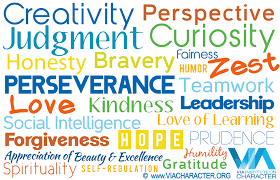
Character Strengths

https://nziwr.co.nz/shop/ How can focussing on our character strengths help us to improve learning? Self esteem? Those who are not ...